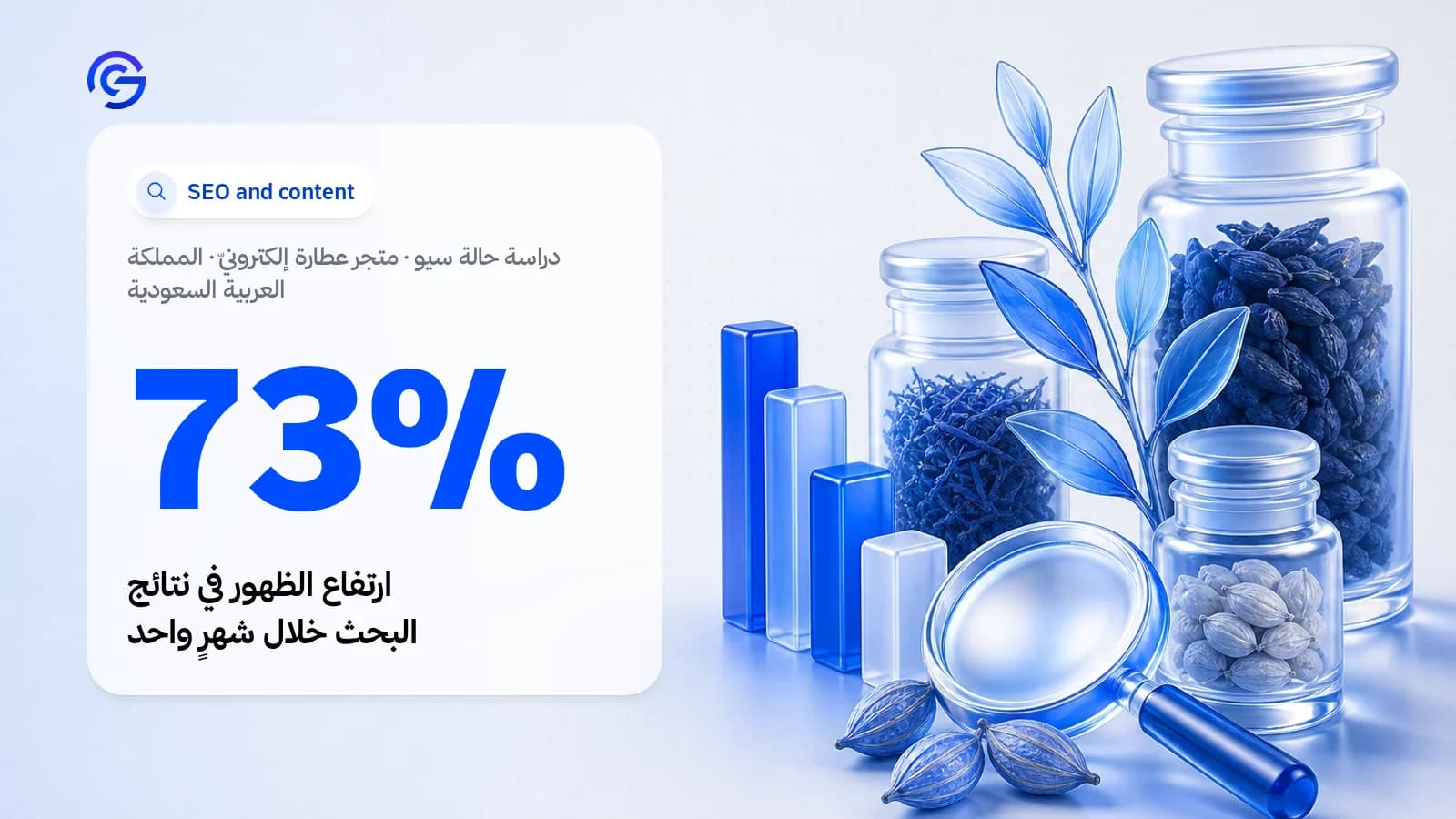
This case shows how a Saudi herbal and spice store took first place for the word "cardamom", and how its search visibility rose seventy-three percent in a single month after months of decline. The core idea of ecommerce category page SEO is simple: the category page ranks for the big word, not the product page. The details are what make the difference.
We did this work as part of our search engine optimization services, and more of our projects are in Graphica's work. The searches in this case were made in Arabic; English renderings are shown.
Most store owners want the first result for the best-known product in their field: "cardamom", "coffee" or "spices". But they try from the wrong place: a longer description for one product page, or a general blog post, then they wait. Usually nothing happens, because a search engine will not put a page for one bag of a set weight first for a broad word.
When a store's reputation doesn't reach the search engine
The store is a known name in the Saudi herbal market. It sells cardamom, coffee beans and coffee, spices, saffron, herbs and natural care products, and it has a customer base that knows it by name. But people who know its name reach it anyway. The real question was: does someone searching "cardamom" who doesn't know the name find it?
The answer was no, and less so every month. According to specialised SEO tools, the store's estimated search traffic had fallen to about half of what it had been, and the number of keywords it appeared for had been shrinking since the start of the year, down to two hundred and seventeen. The store was not standing still; it was losing ground month after month.
What the first audit found
When we examined the store from the inside, the cause was not a mystery:
We then compared the store with three prominent competitors in the same market, and found the picture reversed. Their product pages explained benefits, uses and preparation. The largest ranked for more than four thousand five hundred keywords, and the other two for about eight hundred to a thousand each.
The keywords the store shared with its largest competitor were very few compared with what that competitor ranked for alone.
To make the gap concrete, we compared one product page in the store with the matching page at competitors. The store's page held only the name, price, product number and quantity. The competitor's page explained the same product in several sections: its benefits for skin, hair and children, how to use it, and details of its type and packaging. A search engine can only choose the page that says something.
The big word is never won by a product page
We had two roads. The first was to write product content one page at a time until we caught up with competitors: correct, but long, and with no promise of ranking for the big words. The second was to ask: which page in the store deserves to appear when someone types "cardamom"?
The answer is the cardamom category page. Someone searching a broad word hasn't decided what to buy yet; they want to see the types, the prices and the differences, then choose. The category page is the only page that shows them all of that in one place.
The problem is that in most stores the category page is just a grid of images and prices, without one sentence telling the search engine what the page is about. So the engine passes it over for stores that wrote enough.
So we built the work on "category before product". The category page is the gateway that targets the big word, product pages target the long phrases branching from it, and articles answer the category's questions. Each layer links to the other two, so the search engine sees the store as a complete reference for that category, not a set of scattered pages.
A three-layer keyword map
We built the keyword map for each category on the same three layers. In the cardamom category, for example, the word "cardamom" alone was searched about seventeen thousand times a month in the Kingdom according to specialised SEO tools, and it became the category's word.
Below it sit longer phrases carrying the type, the trade name and the weight, such as Indian cardamom under its well-known trade names and American cardamom by grade: these are product words. Then come questions such as the types of cardamom, its price and its benefits: these are article words.
| Layer | Kind of keyword | Examples from the cardamom category |
|---|---|---|
| Category | A broad, high-volume word | cardamom, types of cardamom, best cardamom |
| Product | A long phrase that pins down what the buyer wants | Indian cardamom with a trade name and set weight, a bag of American cardamom |
| Article | A question before or after buying | cardamom price in Saudi Arabia, cardamom benefits, benefits of chewing cardamom |
We drew the keywords from more than one tool and from an analysis of what competitors actually rank for. Then we divided them so that no two pages of the store compete for the same phrase: articles never target the category's word, and products never target an article's word.
Layer one: the category page
We wrote category descriptions that target each category's main word and name the types it contains, and gave every category its own search title and meta description. The cardamom category's title in the results went from a single word to a line about the best Indian and American cardamom in Saudi Arabia. We applied the same structure to Turkish coffee, Saudi coffee, saffron, herbal tea and others.
This layer carried the biggest results. The cardamom category now holds first place for "cardamom" according to specialised SEO tools, and it was among the store's fastest-growing pages in clicks over the last month according to Google Search Console.
The Turkish coffee category appears second for searches for the best Turkish coffee in Saudi Arabia, and third for the best ready-made Turkish coffee.
What does a category page that ranks contain?
Not every written category page can rank. A generic line like "a great selection at the best prices" tells the search engine nothing. The page we built brings together five elements:
The last element is the one most store owners miss. A well-written category page that no link inside the store reaches stays isolated in the search engine's eyes, however good its content.
Layer two: product pages
The store had four hundred and thirty products, most of them with no description. So far we have rewritten the content of two hundred and twenty-five of them. Every page followed a clear structure: an introduction to the product and its type, then its features and uses in organised sections, then common questions. Each product got a search-oriented name carrying the type and weight, plus its own title, meta description and URL.
On every page we added internal links to its category and to similar products. Internal links are not a detail here: they tell the search engine that all these products belong to one category led by the category page, so the strength of each page flows to the whole category.
Further reading: Google's guide to ecommerce site structure.
In the cardamom category the result of this layer was clear. The store now appears second for four well-known trade names of Indian cardamom, and fourth for a bag of American cardamom. In coffee it appears first for Harari coffee with mastic and shiba, fourth for plain Khawlani coffee, and fourth for the cheapest tin of saffron.
A product page: before and after
Before the work, the typical product page showed the image, name and price, with three tabs below: product information with the product number and quantity, product description (empty), and reviews. The search engine could not find a single sentence on the whole page explaining what was for sale.
After the work, the same page carries a name with the type and weight, a description of the product and its uses in sections with clear headings, short answers to common questions, links to the category and similar products, described and compressed images, and its own search title, meta description and URL.
The difference between the two pages is not length alone. The second answers what the buyer asks; the first answers nothing.
Layer three: articles
Articles in this structure are not general content published to fill a blog. They answer the questions of one specific category and connect the reader to the category and its products. In the last month alone we published fifteen long-form articles, each between one thousand six hundred and ten and two thousand five hundred and fifty words:
- Cardamom: five articles on the best types for coffee, its price in Saudi Arabia, its benefits, its benefits for women, and the benefits of chewing it.
- Coffee: two articles on types of Arabic and Saudi coffee and roast levels, and the best Turkish coffee in Saudi Arabia.
- Nuts: two articles on the best types of nuts, and nuts allowed on the keto diet.
- Natural care: three articles on herbal-store hair and skin care products, and the benefits of sidr for hair.
- Herbs and frankincense: three articles on how to use Makkah senna, the types of Omani frankincense, and its benefits.
Every article points to its category and related products, so a reader of the cardamom types article finds direct links to the types of cardamom the store stocks. Today the article on cardamom's benefits for women appears fifth, the article on how to use Makkah senna sixth, and the hair care and skin care articles appear as sources in AI answers and then as the first result below them.
On content formats in general: the types of content marketing.
The technical foundation under the three layers
Structured data
We followed up the products' structured data until the search engine accepted three hundred and three product snippets with no errors; these show price, availability and rating directly in the results. It also accepted three hundred and thirty-seven breadcrumbs, the line that shows where a page sits inside the store and confirms to the search engine that a product belongs to its category.
The reference: Google's product structured data guidelines.
Indexing
We submitted the sitemap and tracked how it was read, and requested fresh indexing for every product and article as soon as it was updated, so the search engine read the new content instead of keeping the old empty version. The number of indexed pages reached six hundred and fifty-seven.
Images and speed
We added alt text naming each product and its type to the product images, and compressed them while keeping them clear. In one batch, compression saved sixty-six percent of the size of seven images, and one product image went from one hundred and forty-five kilobytes to twenty-one.
We then compared a product page in the store with the same product's page at a competitor. The store scored a higher performance score, and a much shorter wait before the page responded to the visitor.
The results: visibility up seventy-three percent in a month
For traffic and visibility figures we rely on Google Search Console alone, because it measures what actually happened, not what outside tools estimate. In the last twenty-eight days the store appeared in search results one hundred and eighty-eight thousand times, against one hundred and nine thousand in the period before, and clicks rose from four thousand eight hundred and sixty to five thousand seven hundred and eighty.
Across the whole period since the store was connected to Search Console, it recorded fifteen thousand five hundred clicks and three hundred and eighty-five thousand impressions, at an average position of fifth. The daily impressions curve kept climbing throughout, and clearly accelerated in the final weeks.
Categories: cardamom leads
When we split impressions by category, cardamom led by a wide margin: sixty-five thousand impressions on searches containing the word "cardamom", of which forty-three thousand seven hundred and six were for the word "cardamom" alone.
Next came the Qassim blend with thirteen thousand five hundred, at an average position better than second, then spices. Oils and nuts began to appear in the final weeks after almost no visibility before.
The Qassim blend: a small category at the top
If cardamom is the biggest category, the Qassim blend is the one with the clearest ranking. The store appeared thirteen thousand five hundred times on searches containing this phrase during the work, at an average position better than second.
Its visibility was not limited to the main phrase. It spread to its variants: Qassim blend for coffee, with saffron, with cardamom, large and small, and even the question of how the original blend differs from imitations.
This category's visibility was almost nil in the first weeks of the work, then rose sharply and held at its new level to the end of the report. Holding steady after the jump suggests the search engine settled the page in its position, rather than showing it in passing.
AI answers: the categories up front
The store appeared in AI answers twenty-five thousand two hundred times during the work, with a clear jump in the final weeks. Notably, after the home page, the pages that appeared most there were the cardamom category page, then the sidr for hair article, then the Turkish coffee category page.
So the category pages we wrote for did not only rank in the traditional results; they became a source that Google's AI quotes.
Growth from beyond the store's name
According to specialised SEO tools, the number of keywords the store appears for in the Saudi market rose from two hundred and seventeen to three hundred and seventeen, after shrinking before the work began. According to the same tool, more than four fifths of the traffic now comes from searches that do not name the store. For a known brand that is the measure that matters most: buyers arriving who did not know it before.
How we measured the results
Outside SEO tools differ in their traffic estimates for any site, and the gap between them and the real figures can be several-fold. So we set a simple rule for this case: every traffic, impressions and clicks figure comes from Google Search Console alone, because it records what actually happened in search results.
We used specialised SEO tools for what Search Console doesn't measure: the keyword count before and after the work in the same tool, monthly search volume, the store's position for "cardamom", and the share of traffic that doesn't name the store.
We left out the estimated traffic figures outside tools show, even though they are much larger, because a case study that picks the largest available number loses its value at the first comparison. We also excluded the store's visibility in Google Maps, because it reflects customer reviews of its shop, not our work on the site.
To see what Search Console measures: Google's explanation of the Performance report.
Where the store stands in search results today
| Search phrase | The store's position |
|---|---|
| cardamom | First place |
| Trade names of Indian cardamom (four phrases) | Second in each |
| Bag of American cardamom | Fourth |
| Cardamom benefits for women | Fifth |
| Qassim blend | Average position better than second |
| Best Turkish coffee in Saudi Arabia | Second, with the category page |
| Best ready-made Turkish coffee | Third, with the category page |
| Harari coffee with mastic and shiba | First |
| Bag of plain Khawlani coffee | Source in the AI answer, and first result below it |
| Plain Khawlani coffee | Fourth |
| Cheapest tin of saffron | Fourth |
| Saffron stamen powder | In the top image results, and eighth in the results |
| Best herbal-store skin care products | Source in the AI answer, and first result below it |
| Best herbal-store hair care products | Source in the AI answer, and first result below it |
| Nuts allowed on keto | Source in the AI answer |
| How to use Makkah senna | Sixth |
The table shows that the strongest positions came where all three layers were complete: cardamom with its category, products and articles, and Turkish coffee with its category and article. That is why we see the structure itself, not the number of pages, as the cause of the result.
Why did the category page succeed where the product page fails?
Three lessons for any store selling well-known categories
- Start with the category page. If the biggest word in your field is a category name, the category page is the candidate to rank for it. Write for it before you write for dozens of products.
- Finish one category before you spread out. One category completed with its products and articles beats ten half-written ones. A completed category gives you early proof that the structure works.
- A known name doesn't replace SEO. A store's reputation brings people searching for it by name, but real growth comes from people searching for the product who don't know the store, and they arrive only through broad words.
What isn't finished yet
The store still has clear work ahead. About half of the products have no content yet, and completing them is the first step of the next phase.
Click-through rate also dipped in the last month as visibility widened. Most likely, much of the new visibility came on keywords where the store is still outside the top positions, and lifting it there is what turns impressions into visits. The same goes for image search, which recorded two hundred and seventy-eight thousand impressions during the work while its clicks stayed limited.
After the products come the keywords competitors rank for and the store doesn't, to be targeted with the same structure: a category that leads, products that branch, and articles that answer.
Frequently asked questions about ecommerce category page SEO
Is a paragraph at the top of the category page enough?
A paragraph is a start, but not enough alone. A category page needs a title and meta description written for search, copy that explains the category's types and how they differ, and links reaching it from products and articles. A well-written category page that no link inside the store points to stays isolated in the search engine's eyes.
Won't the category page compete with the product pages?
Not if the keywords are clearly divided. The category targets the broad word, the product targets the long phrase carrying the type and weight, and the article targets the question. Competition starts when targets overlap, so we split keywords so no two pages chase the same phrase: articles never target category words, products never target article words.
Why did impressions rise faster than clicks?
Because a search engine first shows pages for new keywords at mixed positions, then lifts them as they prove useful. Clicks follow position, so we treat impressions as an early signal and work on turning them into visits. In this case, much of the new visibility came on keywords where the store was still outside the top positions.
Does this structure work for stores other than herbal stores?
Yes. Any store selling categories with broad names people search for, such as coffee, perfume, tools or clothing, can make the category page its gateway to the big words in its field. One category completed with its products and articles beats ten half-written ones, and a completed category gives you early proof that the structure works.
Make your category pages the gateway to your field's biggest words
At Graphica we build your store's SEO on three layers: a category that ranks for the big word, products that catch the long phrases, and articles that answer your buyers' questions.
Ask Graphica's team for an initial review of your store, or read another case: how a new jewelry store reached Google's AI Overview.