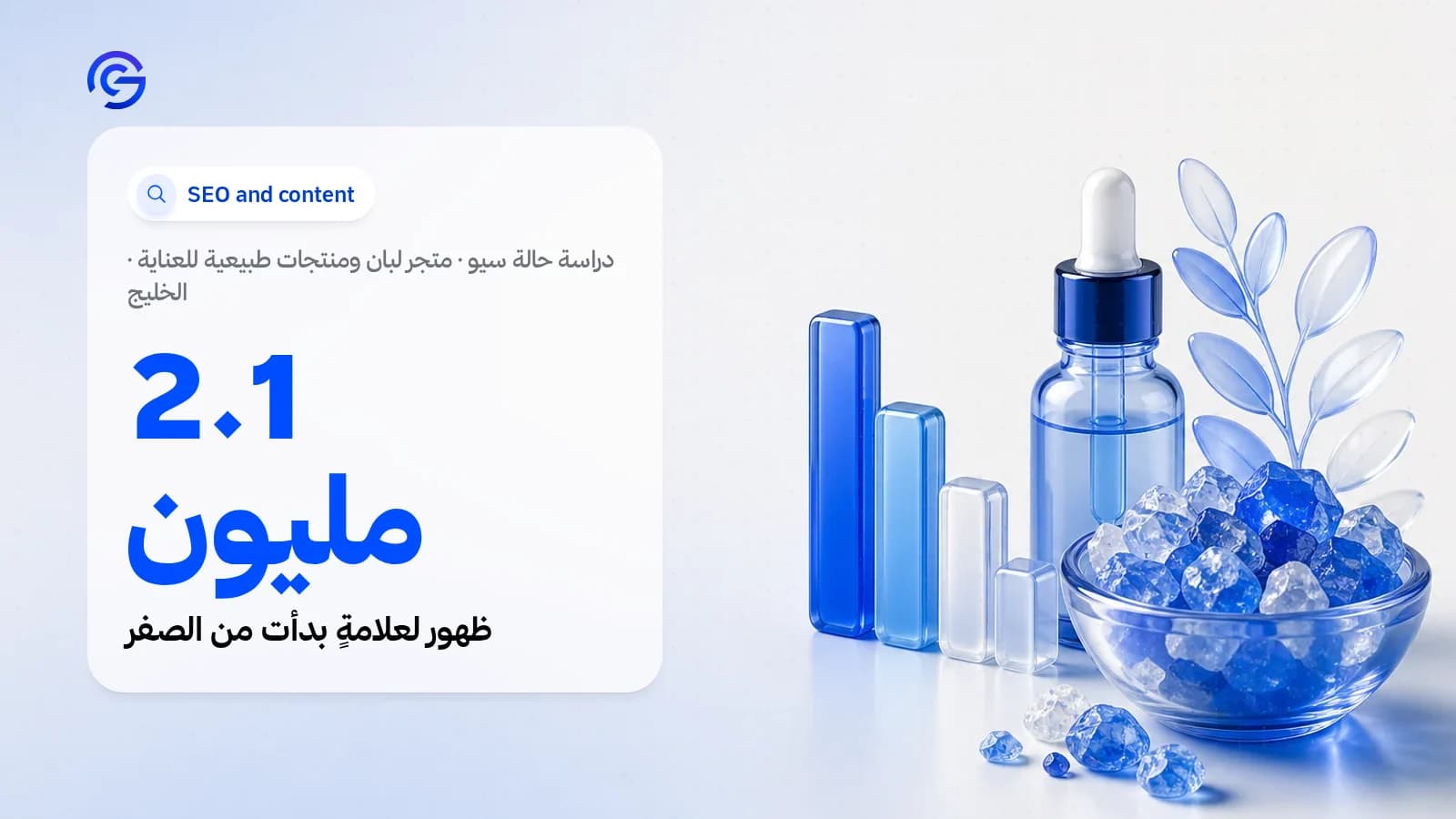
This is a natural skincare store SEO case study: a natural care brand built from zero that used one huge broad keyword as a bridge to its audience, reaching 2.1 million impressions and 10.9 thousand clicks at an average position of 7, with featured snippets on frankincense and skincare searches. The challenge: its products are specialised (skincare creams and serums), while the biggest keyword in its field, "frankincense", is a broad one people search for incense, health and skincare alike.
The answer was the bridge keyword: rank for the huge broad keyword to attract the wide audience, then connect that audience, through content, to the specialised skincare products. What follows explains the bridge keyword and how it is put into practice.
The work behind it was search engine optimization that started the day the store launched, and more of our projects are in Graphica's work.
The problem: a huge keyword that doesn't sell, and a specialised product nobody sees
Many specialised brands hit the same wall in SEO. Their products are specific and precise, and the keywords that describe them precisely have small search volumes. The big keywords in their field are very broad, searched by an audience with mixed intentions, most of whom do not want that particular product.
This case is a clear example. The brand sells specialised skincare products made with frankincense: creams for melasma and brightening, serums, moisturisers. The keywords that describe these products precisely have limited volume. The word "frankincense" itself, on the other hand, is searched a great deal, but someone searching it may want incense, a health use, or simply general knowledge, not necessarily a skincare cream.
Both traditional options fall short. Targeting the specialised keywords alone means narrow presence, slow growth and a low ceiling. Targeting the broad keyword alone means wide visibility in front of an audience mostly uninterested in the product: plenty of visits and no sales. The answer was not to pick one, but to connect them.
What is a bridge keyword?
A bridge keyword is a broad, high-volume keyword that does not sell the product directly, but attracts the wide audience that contains the potential customer. Its job is not to sell but to open the door: to reach an audience the specialised keywords cannot reach on their own.
A bridge keyword does not work alone, though. Its value appears only when an actual bridge is built on top of it: content that carries the searcher from a general interest to the specialised product. Without that bridge, the broad keyword stays visibility without conversion. With it, the keyword becomes the widest channel for winning customers.
In this case "frankincense" was the ideal bridge keyword. Frankincense is tied to incense, heritage and health, and a wide audience searches for it. But it is also, and this is where the opportunity lay, an effective ingredient in skin and hair care. That overlap between the general meaning and the specialised use is what made the keyword fit to be a bridge: someone searching frankincense for any reason can be led, through the right content, to its use in skincare.
Why does the bridge keyword work in natural products?
The natural products sector suits the bridge keyword strategy particularly well, for a structural reason: a single natural ingredient often has many uses. Frankincense is a textbook example, used for incense, for health and for skincare. Collagen, sandalwood and myrrh are all ingredients with overlapping uses too.
That variety creates a double opportunity. First, the broad keyword for the ingredient (frankincense, sandalwood, myrrh) has high volume because it gathers everyone searching for every use. Second, an audience searching for one use is open to another, because the ingredient itself ties them together. Someone reading about the health benefits of frankincense may care about its benefits for the skin, because what drew them in (natural and effective) applies to both.
Other sectors do not allow this link so easily. Someone searching "car" cannot easily be bridged to one specific specialised product. But someone searching "frankincense" can be bridged naturally to "frankincense cream for the skin", because the ingredient is the same and the logic connects. That is what makes natural products fertile ground for this strategy.
The three stages: reach, connect, convert
- 1Reach through the broad keywordRanking for frankincense and its branches: its benefits, its uses, its types
- 2Connect through contentContent that starts from the searcher's question, then leads naturally to the brand's products
- 3Convert through specialised keywordsSmaller keywords that reveal intent close to buying
Stage one: reach through the broad keyword
The first step was ranking for "frankincense" and the broad, high-volume keywords that branch from it: the benefits of frankincense, its uses, its types. These keywords bring the largest possible audience in the field. Ranking for them, with featured snippets on many, put the brand at the top of the results in front of thousands of searchers every month (for background, see Google's guide to featured snippets).
It matters to understand this stage's role precisely: it does not sell. Someone searching "benefits of frankincense" is not necessarily buying a skincare cream. But it builds wide reach, which the small specialised keywords can never deliver. Without this stage, the potential audience stays outside the brand's reach altogether.
Stage two: connect through content
This is where the bridge is actually built. It is not enough for the general searcher to arrive; they have to be led from a general interest to the specialised product. That was done with carefully designed content: it starts from the searcher's question (what are the benefits of frankincense?), answers it honestly, then widens the answer to cover its benefits for skin and hair, leading naturally to the brand's products (for background, see Google's guidance on creating helpful content).
The key at this stage is that it feels natural. The move from general to specialised has to be logical, not forced. A searcher reading about the natural benefits of frankincense finds its use in skincare a logical extension of what they are reading, not an advertising leap. This linking content is the real heart of the strategy; without it, the broad audience and the specialised product stay in separate worlds (on content formats in general, see the types of content marketing).
Stage three: convert through specialised keywords
At the other end of the bridge, the target was specialised keywords that reveal intent close to buying: a cream for treating melasma, frankincense for hair, myrrh for the face, sandalwood for the skin. These keywords have smaller volumes, but the searcher knows what they want, and converts at a higher rate.
Ranking for these keywords, with featured snippets on a number of them, caught the specialised audience at the moment it was close to deciding. Some of that audience arrived directly through these keywords, and some crossed the bridge from the broad stage. Both meet here, at the product, where the conversion is completed.
The role of the right start from zero
One decisive factor made these results possible: the site was built and SEO started the moment it launched, not years later. A new store built on a sound search foundation from its first line avoids the cost of later repairs that weighs down sites started without search in mind.
That timing, a correct build with immediate SEO, is what allowed the fast climb from zero to 2.1 million impressions. At no stage did the site have to stop and fix a structural fault, so all the effort went into growth. A clean structure from the start helped search engines understand and trust the site faster, which explains how quickly it built presence on a competitive keyword like "frankincense".
The lesson goes beyond this case: the best time to start SEO is the moment the site is built, not after. A new brand that starts right saves itself years of catching up with competitors.
Natural skincare store SEO: the numbers
The site went from no presence at all to the following figures:
| Metric | Value |
|---|---|
| Total impressions | 2.1 million |
| Clicks | 10.9 thousand |
| Average position | 7 |
| Ranking keywords | More than 640 keywords |
The site's performance since launch: a start from zero, a strong climb to a high peak, then a steady, high level. A path that reflects a solid build from the starting point.
More important than the absolute figures is what they show about the bridge strategy working: the huge visibility (2.1 million impressions) came mainly from the broad keyword, while the clicks and conversions came from the specialised keywords at the other end.
The spread of keywords shows the logic:
"Frankincense" sits at the top with by far the most impressions, as the broad keyword that attracts. Below it come specialised keywords (collagen for women, frankincense for hair, myrrh for the face, hand exfoliating ointment) that are smaller and closer to buying. This spread is no accident; it is the bridge strategy made visible: a broad keyword that attracts, and specialised keywords that convert.
Because the target market is the Gulf and the Arab world, visibility spread across several countries, with a base in Oman and then expansion to the rest of the Gulf and the Arab world. The broad keyword, which crosses borders by nature, served that geographic reach well.
When does the bridge keyword strategy work?
Not every brand is a candidate for the bridge keyword strategy. It needs two conditions together, and without either one it does not pay off.
Condition one: a broad keyword connected to the product. There has to be a huge broad keyword that can be logically connected to the specialised product. Frankincense connects to skincare because it is the ingredient. If the broad keyword were completely unrelated to the product, the bridge would collapse. A natural overlap between the broad keyword's meaning and the product's use is essential.
Condition two: an audience able to move. The audience searching the broad keyword has to be open to the specialised product. Someone reading about the benefits of frankincense is open to a frankincense cream, because what drew them in (natural and effective) applies to both. If the two audiences differed in intent and interest, nobody would cross the bridge.
The sectors that suit this strategy best are those built on a broad, versatile ingredient or concept: natural products, supplements, some care and nutrition products. Where the broad keyword is unrelated to the specialised product, it is better to target the specialised keywords directly, without trying to build a bridge with no foundation.
Frequently asked questions about the bridge keyword
What is the difference between a bridge keyword and an ordinary broad keyword?
With an ordinary broad keyword, visibility is the goal. With a bridge keyword, visibility is a way to reach an audience that linking content then moves towards the specialised product. The difference is not the keyword but the bridge: content that turns a general searcher into a customer. A broad keyword without a bridge stays visibility without conversion.
Is ranking for a huge broad keyword enough to grow sales?
No, not on its own. A broad keyword brings an audience with mixed intentions, much of it uninterested in the product. Ranking for it builds visibility and reach, but turning that into sales takes content that connects the broad audience to the product, and specialised keywords that capture buying intent. The broad keyword starts the path, not ends it.
Does the bridge keyword strategy suit every store?
No. It works only when there is a broad keyword logically connected to the product, and an audience able to move from the general to the specialised. Natural products built on a versatile ingredient (frankincense, sandalwood, collagen) are ideal for it. When the broad keyword is unrelated to the product, targeting the specialised keywords directly makes more sense.
Why would a new store start with a huge competitive keyword instead of easy ones?
Because a huge keyword, if it is a suitable bridge, opens access to a wide audience that small keywords cannot reach. A new store that starts on a sound foundation from launch can build presence on these keywords gradually, especially through featured snippets. Easy keywords alone build presence with a low ceiling; the bridge keyword raises the ceiling.
How long does a new store need to build presence on a broad keyword?
It depends on the keyword's competition and the quality of the technical foundation and content. A store that starts on a sound foundation, with content that serves the searcher's intent, can enter featured snippets for broad keywords gradually. Growth from zero takes time while search engines learn to trust a new domain, but the right start shortens that path.
Your new brand deserves to be seen
If you are launching a specialised brand and find its precise keywords small while the big keywords are broad and far from your product, the bridge keyword strategy may be your key. A broad keyword connected to your product, content that connects, and specialised keywords that convert: a formula that builds wide presence from zero.
The best time to start SEO is the moment you launch your brand. And the right keyword opens the door to a whole market.
Talk to Graphica's team, or read another case: how a new jewelry store reached Google's AI Overview.