Company logo design starts with a written brief about your business and customers, not with drawing. Then come rough sketches of different ideas, development of the chosen one, tests at every size and on every background, and finally a set of files ready for print and screens, with the rules for using them. A good logo is simple, reads as a tiny icon, works in one colour, sets you apart from competitors and can be registered in your name.
In this guide we go through those stages one by one: the types of logos and which suits you, what happens at each stage, the files you should receive, and how a logo maker, a freelance designer and an agency differ. If you are looking for someone to design yours, that is what we deliver in company logo design as part of our brand identity service.
What makes company logo design work?
A logo is not a painting to hang on a wall. It is a working tool that appears in very different conditions: a social media icon the size of a fingernail, a shopfront sign, a stamp on an invoice, a one-colour print on a paper bag. You judge it by how well it works in all of them, not by how good it looks on a large screen on presentation day.
That last quality separates a logo you own from a logo you merely use. A logo built from a stock symbol or an available template could turn up on someone else's van tomorrow, and the law will not protect you from it. That is why professional logo design starts from an idea that belongs to you: your name, the story of your business, or a shape tied to what you offer.
A logo is still only one element of a larger system. Colours, typefaces, image style and usage rules are what make a brand look the same everywhere. Here we focus on the logo itself: how it is designed, and what you should have in hand at the end.
Types of logos: which suits your company?
Before any drawing, one question is settled: should your logo rely on lettering, on a symbol, or on both? No type is better than the others. The right one depends on your name and its length, and on the channels where your brand will appear most.
| Type | What it is | When it suits you | Watch for |
|---|---|---|---|
| Wordmark | The company name in drawn or customised lettering | A short, distinctive name you want people to remember | Long names shrink and weaken in icons |
| Lettermark | The initials of a long name | A name of several words that people already shorten | Takes time before customers link it to the full name |
| Symbol | A mark or shape with no lettering | A well-known brand, or a business across several markets and languages | A symbol alone does not introduce a new company |
| Combination mark | A symbol and a name used together or apart | Most new companies and online stores | Needs horizontal, stacked and symbol-only versions |
| Emblem | The name inside a frame or closed shape | Cafés, bakeries and traditional products | Fine detail disappears at small sizes |
In the Saudi market there is also the question of language. If your brand will appear in Arabic and English, both names are best designed together from the start, with roughly the same weight and height, rather than adding the English in a stock typeface after the Arabic is approved. Custom-drawn Arabic lettering gives a logo a character that ready-made typefaces cannot, but it takes longer to design and test.
Most new companies end up with a combination mark, because it gives them flexibility: the full logo on the website and the sign, and the symbol alone as an account icon or on a small package.
The stages of company logo design, from idea to sign-off
A logo drawn straight away reflects the designer's taste, you pick from it by yours, and neither of you measures anything against what your customers need. The stages below make each decision rest on the one before it, and cut the revision rounds that eat up time on projects that stall.
- 1The briefYour business, customers, competitors and the impression you want, on one page you approve
- 2Rough sketchesGenuinely different ideas, on paper or on screen, not variations of one idea
- 3DevelopmentThe chosen idea redrawn in clean lines, with its colours and companion typeface
- 4TestingSmall and large, colour and one-colour, light and dark backgrounds, both languages
- 5Final filesThe source file, vector and image formats, and the usage rules
The brief is the shortest stage and has the biggest effect. It records what you sell and to whom, the impression the logo should leave, and what your competitors do so you avoid repeating it. When your team later disagrees about a design, everyone goes back to this page instead of personal taste.
Rough sketches show ideas that are genuinely different: lettering-based, symbol-based and combined. Choosing between three versions of one idea is not a real choice. AI tools help at this stage by producing many moodboards quickly, but the logo itself is drawn by a designer, as we explain in our article on AI and brand identity.
Development turns the chosen idea into a vector drawing with clean lines and precise proportions, often on a construction grid that keeps the shape balanced. This is where the logo's colours and companion typeface are chosen, and its horizontal, stacked and symbol-only versions are designed.
Testing is what separates a logo that looks good in a presentation from one that actually works. Put it in an account icon, on a product photo, in black and white and next to your competitors' logos. Problems found here are fixed before handover, not after the signs and packaging are printed.
What to prepare before the first session
- Your name as it will be written: in Arabic and English, with any abbreviation you use.
- Your business and customers: what you sell, to whom, and why customers choose you over others.
- Your direct competitors: who they are, and what you like or dislike about their logos.
- Where the logo appears first: an online store, social accounts, a sign, packaging or vehicles.
- The decision-maker: who approves the direction and the final design at each stage.
The final files: what should you receive?
Many business owners receive their logo as a single PNG, then find at the first sign or print job that it is not enough. The printer wants a vector file, the website needs a light version, and the social account needs a square symbol. A complete handover covers all of these from day one.
| File | Type | Use |
|---|---|---|
| Editable source file (AI or equivalent) | Editable vector | Any future change or new version |
| SVG | Vector | Websites and online stores, small in size and sharp at every scale |
| PDF or EPS | Vector | Printers, signage, packaging and engraving |
| Transparent PNG | Image | Presentations, documents and social media |
| JPG | Image | Quick uses that need no transparency |
| Colour codes | Reference | CMYK for print, RGB and HEX for screens, a Pantone reference where needed |
The vector format matters most, because it scales up to the size of a billboard without losing quality. SVG is an open standard for vector graphics on the web published by the W3C, as set out in the official SVG specification, which is why it works in browsers and store platforms without extra software.
One file per format is not enough either. You need a version for each case: the full logo and the symbol alone, horizontal and stacked, each in full colour, one colour and reversed for dark backgrounds. With them comes a short rules sheet: the clear space around the logo, its minimum size, and examples of misuse such as stretching it or changing its colours.
Owning your logo and registering it as a trademark
Ask before you start: who owns the rights to the logo after handover, and are the typefaces licensed for commercial use? A font that is free for personal use only could stop you printing your logo on your own products. Ask for ownership and typeface licences to be written clearly into the proposal or contract.
In Saudi Arabia, trademarks are registered with the Saudi Authority for Intellectual Property. A logo is registered in one or more classes of goods and services, and in many countries those classes follow the Nice International Classification administered by the World Intellectual Property Organization. So search for similar marks before approving the design, and check the current requirements and fees on the authority's own website.
Logo maker, freelance logo designer or agency?
When you look for logo design you will find three main routes: tools that generate a logo in minutes, platforms that list freelance designers, and agencies that design the logo as part of a full identity. Each suits a particular situation, and the real differences are originality, what you receive and who stays with you after handover.
| Logo maker | Freelance logo designer | Design agency | |
|---|---|---|---|
| Originality | Symbols and templates others can use | Depends on the designer and their process | An idea drawn for you and tested |
| Brief and understanding | A few fixed questions | Depends on the designer | A written brief you approve before drawing |
| Files delivered | Often images and limited versions | Depends on the agreement | Source, vector formats and usage rules |
| After the logo | Nothing | May or may not continue | Identity, company profile and print under the same rules |
| When it suits you | Testing an idea before launch | A logo alone on a set budget and timeline | A logo you will build a whole brand on |
A good freelance designer can produce an excellent logo; the difference is not talent. It is that a logo rarely stays on its own: business cards, social accounts, the company profile and packaging follow. When one team designs them all under the same rules, your brand stays consistent without explaining everything again to each new designer.
What sets the cost of logo design?
There is no single right price, because "logo design" can mean a quick sketch or a full project. These factors are what push the cost up or down in any proposal you receive:
- Initial directions: one direction, or several genuinely different ones to choose from.
- Language and lettering: one language, two, or custom-drawn Arabic lettering.
- Revision rounds: how many are agreed, and what is charged after them.
- Scope: the logo alone, or with colours, typefaces, brand guidelines and applications.
Whichever route you take, avoid three common mistakes: starting the design before writing the brief, approving the logo on a large screen without testing it small, and accepting a single image with no source file and no vector versions.
Why choose Graphica for your company logo design?
We design logos through the stages set out in this guide, and these are the reasons Graphica deserves a place on your shortlist:
- A written brief before any drawing: we start with a session with the decision-maker and write the logo brief, and we do not move on to sketches until you approve it.
- A logo drawn by a designer: we use AI for moodboards and mock-ups only; the designer draws the final logo on a construction grid and tests it at every size.
- Arabic and English together: we design both names at the same time, so neither looks like an afterthought.
- A complete, clear handover: the source file, vector and image formats, colour codes and usage rules, with ownership written into the proposal.
- The logo is a start, not the end: we can carry it into your identity, company profile and photography under the same rules.
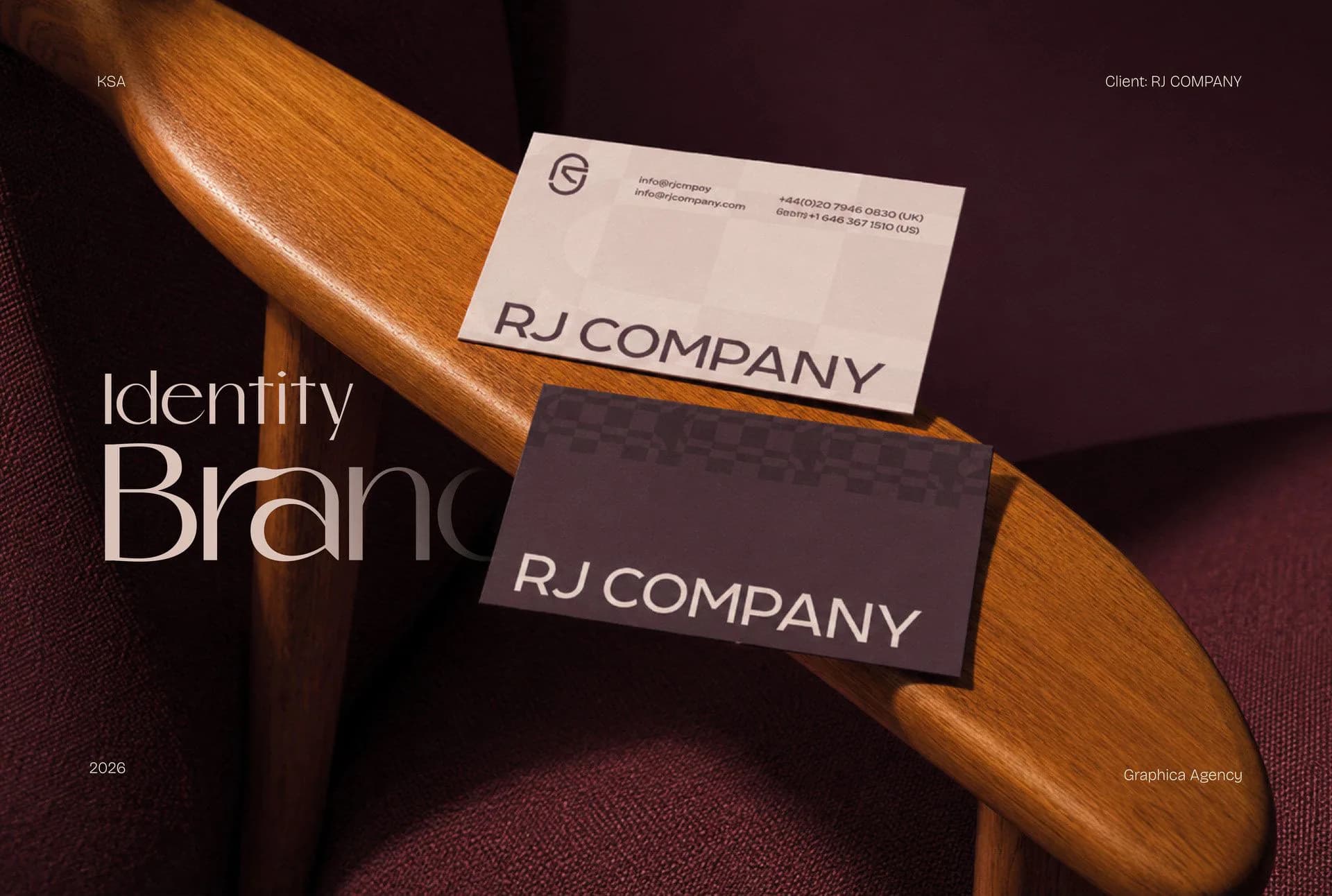
Our work includes the RJ Company brand identity for an interior design firm: we designed the logo mark and its construction grid, set the colour palette and the Arabic and English typefaces, then applied the identity to business cards, letterheads and the staff ID card. There is also the Tallet Al-Khuzama identity for a bakery and café, from the Arabic logo and logo mark to the sign, packaging and cups. We have delivered +150 projects for our clients across all of the agency's tracks.
If you are preparing to launch a company or reviewing your current logo, explore our logo and brand identity design services, or message us on WhatsApp with your company name and a short description of your business.
Frequently asked questions
What are the steps in company logo design?
It starts with a written brief on your business, customers and competitors, then rough sketches of genuinely different ideas, then developing one or two of them digitally, then testing the logo at small sizes, in one colour and on different backgrounds. Once it is approved, the final files are prepared in vector and image formats, with short usage rules.
Which files should I receive once my logo is designed?
The editable source file, vector versions in SVG and PDF or EPS that scale without losing quality, transparent PNGs for screens, and full-colour, one-colour and reversed versions. Alongside them: colour codes for print and screen, the names and licences of the typefaces used, and rules for clear space and minimum size.
Is a logo from an automated logo maker enough for a start-up?
It can do for a while to test an idea before launch, but it is usually built from symbols and templates others can use, so it rarely sets you apart and is hard to register as your trademark. If you will print, build a store and advertise, an original logo drawn by a designer saves redoing it later.
How much does company logo design cost?
Clear factors set the cost: how many initial directions you see, whether the logo is bilingual, whether it needs custom-drawn Arabic lettering, how many revision rounds are included, and whether it comes alone or with an identity and guidelines. So we publish no fixed price; after a short call we send a written proposal setting out what you receive.
Should I register my logo as a trademark before using it?
Ideally, search for similar marks before you approve the design, then file your application with the Saudi Authority for Intellectual Property before printing widely or launching. Finding a clash with a registered mark after your signs and packaging are printed means redesigning and reprinting at once. Check the current requirements and fees on the authority's own website.
Start with your logo brief
Company logo design does not start with picking a shape you like. It starts with a page that says who you are, who you speak to and how you differ. Then come the sketches, the development and the tests, ending with files that cover every use and clear rights in your name. If you would like us to design it with you, send us your request and we will come back with a written proposal setting out what you will receive.